
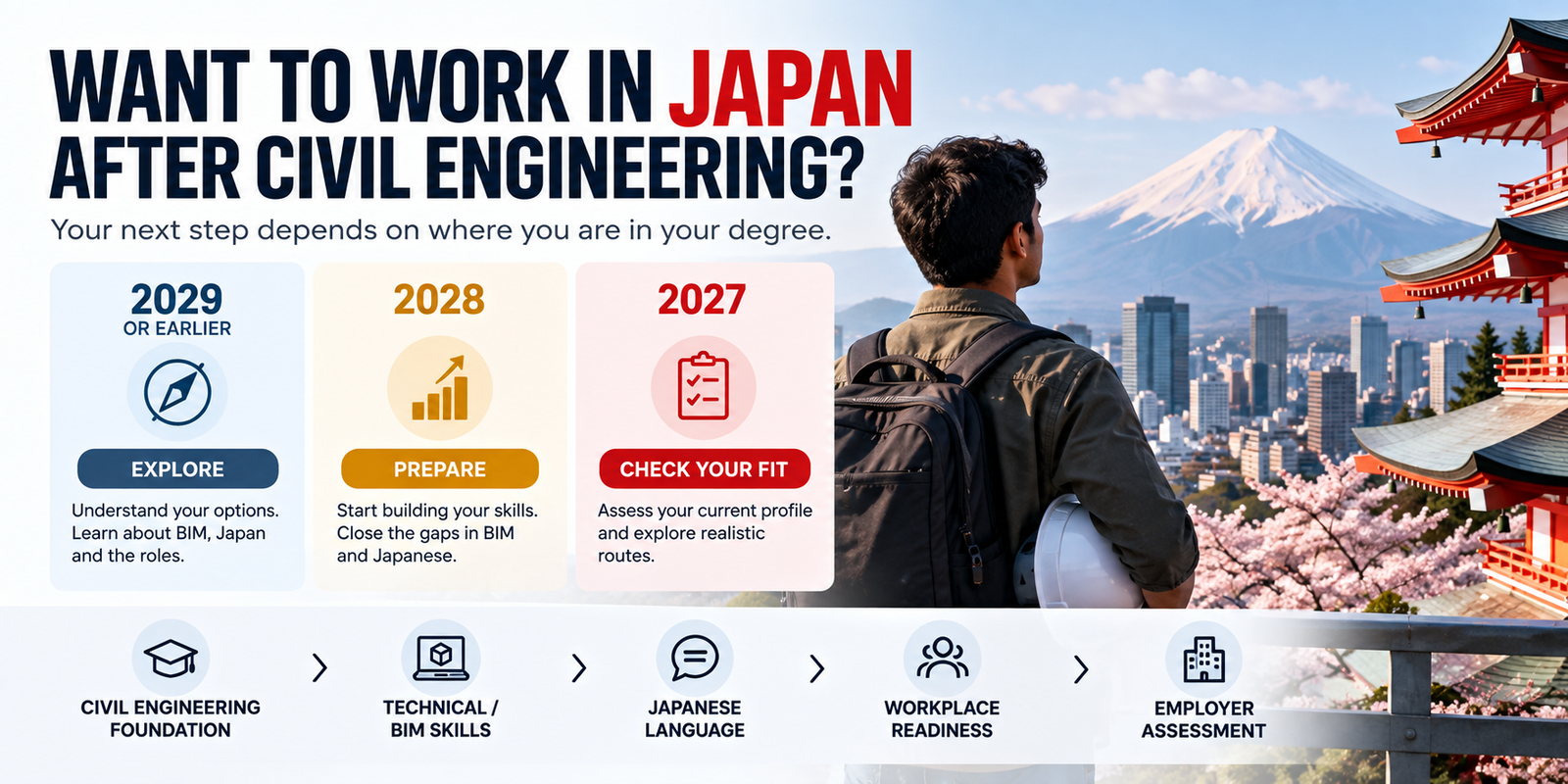
Civil Engineering Student? Here’s When You Should Start Preparing for a Career in Japan
If you are studying Civil Engineering and considering Japan, one of the most useful questions you can ask is not:
“Can I work in Japan?”
It is:
“What should I be doing now to become ready for a career in Japan?”
The answer changes depending on where you are in your degree.
A student graduating in 2029 has time to explore and build skills. A student graduating in 2027 needs to start checking whether their current profile matches the roles and routes they are considering.
That difference matters.
At a recent Bhrighu Academy Japan BIM Career Pathway session, we saw students at several stages asking similar questions about BIM, Japanese, jobs, salaries and the move to Japan.
But they should not all take the same next step.
When should a Civil Engineering student start preparing for Japan?
You do not need to wait until graduation to start.
You also do not need to make a major career or training decision in your first few years of college.
A better way to think about it is:
| Your stage | Main goal |
|---|---|
| Earlier years | Explore |
| Around 1–2 years from graduation | Prepare |
| Final year / graduating soon | Check your fit |
| Graduate / working | Assess your current route |
The earlier you are in your degree, the more time you have to understand what employers may expect and build towards it.
The closer you are to graduation, the more specific your questions should become.
Graduating in 2029 or later? Explore before you decide
If you are still early in your Civil Engineering degree, you do not need to decide today whether you will work in India, Japan or somewhere else.
Use the time to understand your options.
Start by asking:
- What is BIM, and how does it differ from the CAD work I may already encounter?
- What kinds of Civil and BIM roles exist?
- What technical skills do these roles need?
- How important is Japanese?
- What is it actually like to live and work in Japan?
This is also a good stage to build a stronger Civil Engineering base.
Graduating in 2028? Start closing the gaps
Now the question becomes more practical.
Suppose you are interested in BIM but have only used CAD. Or you have studied Civil Engineering subjects but have never worked on a BIM project.
That gives you a clear gap to work on.
You can start learning how BIM fits into design, construction, coordination and project work. You can also begin learning about Japanese and the level of language skill that your future route may require.
This does not mean you need to rush into a programme.
It means you have enough time to prepare with intent.
By the time you reach your final year, you should know much more than simply:
“I want to work in Japan.”
You should have some idea of the work you want to do and what you still need to learn.
Graduating in 2027? Start checking your fit
Instead of:
“Are there Civil Engineering jobs in Japan?”
ask:
“What roles could fit my current profile?”
Instead of:
“Do I need Japanese?”
ask:
“What level of Japanese might my route require, and how will I get there?”
Instead of:
“Should I learn BIM?”
ask:
“What BIM skills do I need for the roles I want?”
This is also the stage when a profile review can become useful.
Your degree, BIM exposure, Japanese level, graduation date, career goal, ability to move and financial readiness can all affect which route makes sense.
Can I work in Japan after a Civil Engineering degree?
A Civil Engineering degree can give you a relevant academic base.
It does not, by itself, make you ready for every Civil or BIM role in Japan.
An employer may also care about your technical ability, BIM skills, Japanese, communication, work readiness and fit for the role.
So instead of treating your degree as the end of your preparation, treat it as your starting point.
Civil Engineering foundation → technical/BIM skills → Japanese → workplace readiness → employer assessment
The exact route will vary by role and employer.
Do I need BIM experience before I start?
Not necessarily.
That does not mean BIM is optional if you want a BIM career.
There is an important distinction:
You may not need BIM to start preparing. You will need to build the BIM skills required for the work you eventually want to do.
For Civil Engineering students, that can include learning BIM software, model coordination, project workflows and how BIM gets used in real construction work.
Your current level tells you where to start.
Is CAD the same as BIM?
No.
CAD experience can give you a useful base, but BIM involves more than producing drawings.
BIM uses digital models and project information across parts of the design and construction process. It can involve coordination between disciplines, changes to models, documentation and shared workflows.
That is why a Civil Engineering student with CAD experience should not assume they are already BIM-ready.
But they are not starting from zero either.
The useful question is:
What do I need to learn to move from my current CAD or Civil Engineering knowledge into BIM work?
Do Civil Engineers need Japanese to work in Japan?
If you do not know Japanese today, that does not automatically rule out preparing for Japan.
But you should not confuse “I don't need Japanese before I start” with “I won't need Japanese.”
For a long-term career in Japan, language can affect much more than interviews.
It can affect communication with colleagues, workplace instructions, reporting and everyday life.
Your required level will depend on the role, employer and route you pursue.
That makes willingness to learn Japanese an important part of the decision.
What else should I prepare for besides BIM and Japanese?
Moving countries for work requires more than technical training.
You may also need to prepare for a different work setting, communication style and daily life.
Think about whether you are ready to learn how teams communicate and report, adapt to workplace expectations, live away from home and operate in another language.
These questions matter because getting to Japan and building a career in Japan are not the same task.
What jobs can Civil Engineering and BIM skills lead towards?
The exact roles available will depend on your profile and the employer.
Areas worth researching include BIM modelling, BIM coordination, structural or construction support, and digital construction or project workflows.
Do not choose a career route based only on a job title or salary figure.
Look at what the work involves and what employers ask candidates to know.
Then compare those requirements with where you are today.
That gap gives you a much better preparation plan.
What should I do if I want to work in Japan after graduation?
Start with your graduation date.
If Japan is still two or three years away, use that time to learn about the market and build your skills.
If you are graduating soon, start testing your assumptions against your actual profile.
You should be able to answer questions such as:
What can I already do?
What do I still need to learn?
How much Japanese am I prepared to learn?
What roles am I preparing for?
How much time and money could the route require?
Am I ready to move countries if the right opportunity comes?
Those answers are more useful than deciding that you simply “want to go to Japan.”
Your next step depends on where you are now
There is no reason for a third-year student and a final-year student to make the same decision today.
If you are earlier in your degree, use the time you have.
Learn about BIM. Understand Japan. Start looking at the skills employers ask for. Build a stronger technical base.
If you are graduating soon, the question becomes more personal:
Does your current profile fit a realistic Japan career pathway?
Bhrighu Academy's Japan Career Pathway Profile Review looks at your academic background, current skills, BIM starting point, Japanese readiness, timeline and career plans to help assess which pathway, if any, may fit your profile.
Graduating soon? Check My Japan Career Fit
Still earlier in your degree? Explore the Japan Career Resource Centre
Bhrighu Academy provides training, preparation and career-entry support. Employment and visa outcomes depend on factors including the candidate's progress, assessments, employer selection and the relevant visa process.